 Image 1 of 1
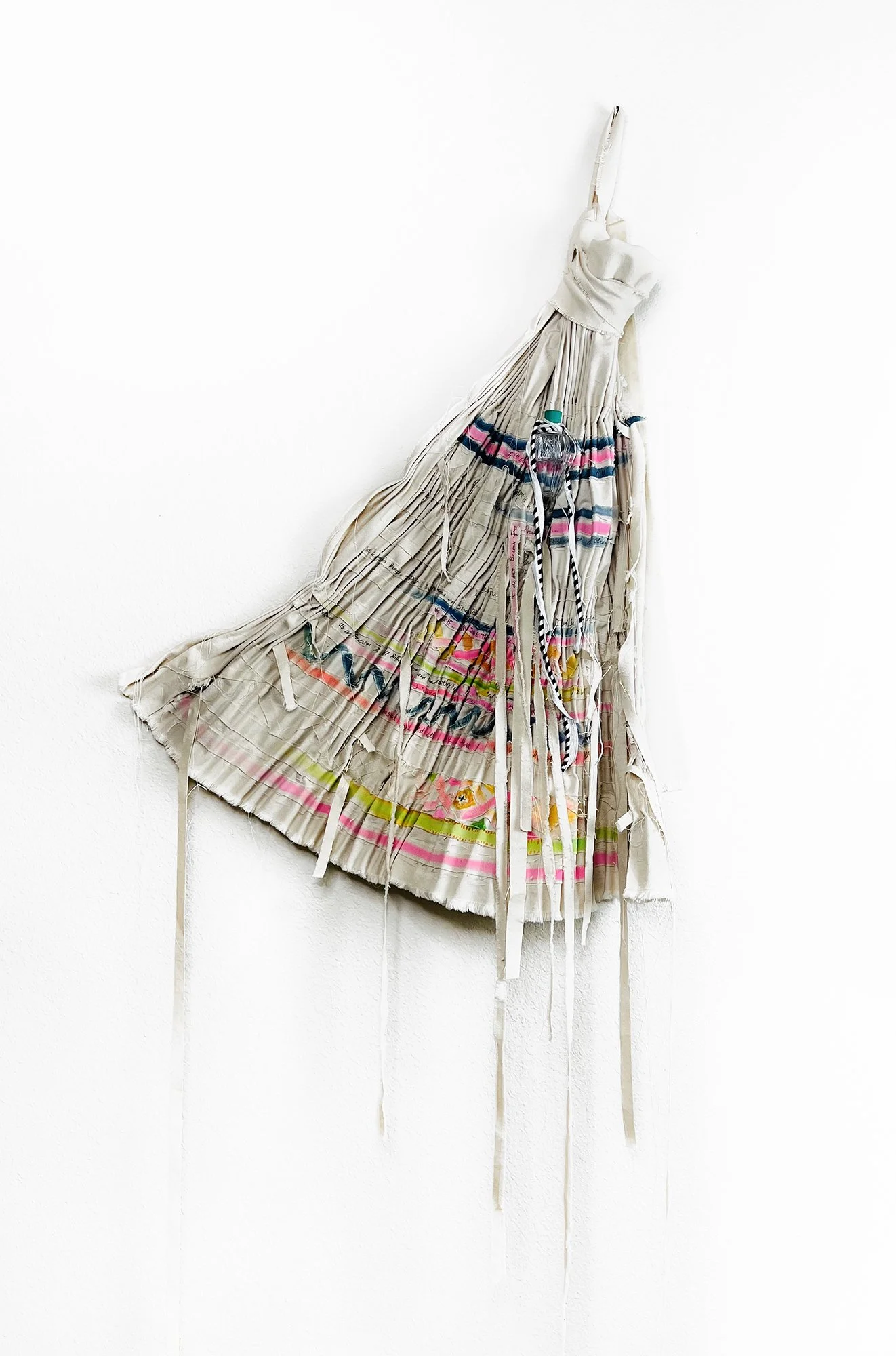
Mixed media on canvas material
36 × 60 in
Fabric remembers what history forgets.
In Hmong culture, the act of stitching has never been purely decorative but carries the memory of displacement written language could not. Women encoded survival into patterns, because patterns could not be confiscated.
That tradition was born from centuries of persecution. Long before the Secret War in Laos, Hmong people were driven from highlands across China by campaigns of suppression that pushed entire communities southward over generations. Hmong families who allied with American forces became targets forcing mass exodus into refugee camps along the Mekong. Survival itself became a form of resistance.
The garment in this piece carries embroidered accounts of that migration. But woven alongside those narratives are wounds that rarely surface in public memory. Fleeing through the Jungles of Laos, women's bodies were violated by soldiers in ways never spoken aloud. Some women tucked poison inside the folds of their traditional dress as a last act of autonomy in a world that offered them none. That detail does not belong in a footnote. It belongs here, at the center of this work, in the fabric itself.
When ICE enforcement actions swept through Minnesota, something familiar returned. Families disappeared overnight. Fear replaced safety. And again, women were left to carry the violations that surfaced in chaos.
This work belongs to every woman who carried something unspeakable in order to keep going, and to every community that has had to stitch itself back together in the aftermath of forces that never saw them as fully human.
Mixed media on canvas material
36 × 60 in
Fabric remembers what history forgets.
In Hmong culture, the act of stitching has never been purely decorative but carries the memory of displacement written language could not. Women encoded survival into patterns, because patterns could not be confiscated.
That tradition was born from centuries of persecution. Long before the Secret War in Laos, Hmong people were driven from highlands across China by campaigns of suppression that pushed entire communities southward over generations. Hmong families who allied with American forces became targets forcing mass exodus into refugee camps along the Mekong. Survival itself became a form of resistance.
The garment in this piece carries embroidered accounts of that migration. But woven alongside those narratives are wounds that rarely surface in public memory. Fleeing through the Jungles of Laos, women's bodies were violated by soldiers in ways never spoken aloud. Some women tucked poison inside the folds of their traditional dress as a last act of autonomy in a world that offered them none. That detail does not belong in a footnote. It belongs here, at the center of this work, in the fabric itself.
When ICE enforcement actions swept through Minnesota, something familiar returned. Families disappeared overnight. Fear replaced safety. And again, women were left to carry the violations that surfaced in chaos.
This work belongs to every woman who carried something unspeakable in order to keep going, and to every community that has had to stitch itself back together in the aftermath of forces that never saw them as fully human.